A cartoon word puzzle is a colorful and entertaining educational activity that combines the excitement of cartoons with the challenge of discovering words. It can be designed on paper, cardboard, worksheets, or a classroom display and can include cartoon characters, pictures, letters, hidden words, matching activities, scrambled words, and simple clues. Because children are naturally attracted to colorful characters and playful illustrations, a cartoon word puzzle can make language learning more enjoyable and memorable.
Word puzzles are useful for developing vocabulary, spelling, reading, concentration, and problem-solving skills. When cartoon pictures are added, the activity becomes even more engaging. A child may see a picture of a cat next to several letters and have to find the word “CAT.” Another puzzle might show a cartoon character holding a book and ask the student to identify the correct school-related word. The possibilities are almost endless.
What Is a Cartoon Word Puzzle?
A cartoon word puzzle is a learning game that uses cartoon images and words together. The main purpose is usually to help children recognize, read, spell, or understand vocabulary.
The puzzle can take many forms. It might be a word search containing cartoon-themed words, a crossword with colorful characters, a matching activity, or a collection of pictures with missing letters.
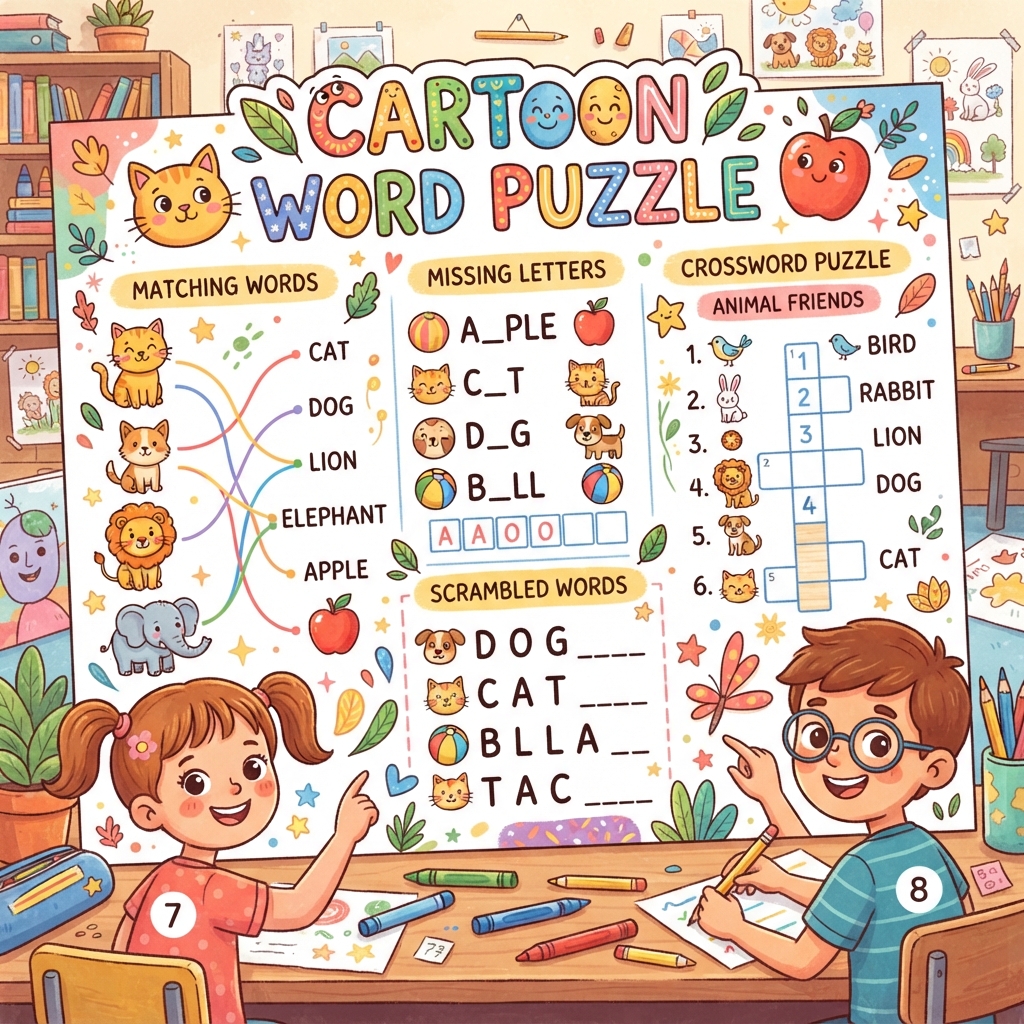
For example, a worksheet could show a cartoon apple and the incomplete word “A__LE.” The student must identify the missing letter and complete the word.
Another version could show several cartoon animals and a list of animal names. Students must draw lines connecting each animal to the correct word.
These simple activities encourage children to think while having fun.
Materials Needed
A cartoon word puzzle can be made using very simple materials. White paper or cardboard can provide the main surface.
Colored pencils, crayons, markers, and pens can be used to draw cartoon characters and write words.
Scissors and glue can be useful for creating a cut-and-paste puzzle.
Teachers can also use printed pictures or handmade illustrations.
For a reusable classroom version, the puzzle can be laminated so that students can write on it with erasable markers.
Using recycled cardboard can make the project inexpensive and environmentally friendly.
Designing the Cartoon Characters
The cartoon characters are an important part of the puzzle. They should be simple, friendly, and easy for children to recognize.
Animals are particularly popular. A cartoon cat, dog, rabbit, lion, elephant, monkey, or bird can represent different vocabulary words.
Children can also create human characters such as students, teachers, explorers, superheroes, or imaginary friends.
The characters can have large eyes, colorful clothing, funny expressions, and interesting poses.
The pictures do not need to be complicated. Simple shapes can create attractive cartoon figures.
Choosing the Vocabulary
The words should match the age and learning level of the children.
For younger learners, common words such as “sun,” “book,” “ball,” “tree,” “cat,” and “house” are appropriate.
Older students can work with longer words, descriptive adjectives, verbs, science terms, or subject-specific vocabulary.
A teacher can create a puzzle based on the current classroom lesson.
For example, a science lesson about animals can inspire a puzzle containing words such as “lion,” “tiger,” “whale,” “snake,” and “butterfly.”
Picture-to-Word Matching
One of the easiest cartoon word puzzles is a picture-matching activity.
Several cartoon pictures are placed on one side of the page, while a list of words appears on the other side.
Students must connect each picture with the correct word.
This activity helps children associate visual information with written language.
It is particularly useful for beginners who are still developing reading skills.
Teachers can make the activity more difficult by adding extra words that do not match any picture.
Missing Letter Puzzles
Missing letter puzzles are another simple and effective activity.
A cartoon image can be placed next to a word with one or more missing letters.
For example:
C _ T
A cartoon cat provides a visual clue, helping the child determine that the missing letter is “A.”
Longer words can contain multiple missing letters.
This type of puzzle develops spelling skills while reinforcing vocabulary.
Scrambled Cartoon Words
In a scrambled-word puzzle, the letters of a word are placed in the wrong order.
A cartoon picture gives the student a clue.
For example, the letters G-O-D can be rearranged to form “DOG.”
The activity encourages children to recognize familiar words and think carefully about letter order.
Teachers can begin with short words and gradually introduce longer ones.
Cartoon Word Search
A cartoon word search can combine a colorful picture with a traditional letter grid.
Students receive a list of words and search for them horizontally, vertically, or diagonally.
The theme might be animals, school supplies, food, transportation, or nature.
For example, a school-themed word search could contain:
- BOOK
- PENCIL
- DESK
- SCHOOL
- TEACHER
- CLASS
- BAG
A cartoon school building or student can be placed around the grid.
This makes the puzzle more visually appealing.
Cartoon Crossword Puzzles
A cartoon crossword puzzle can be designed for older children.
Each clue can be accompanied by a cartoon picture.
For example, a picture of a fish can provide the clue for “FISH.”
Children must enter the correct word into the crossword grid.
This activity develops spelling, vocabulary, reading comprehension, and logical thinking.
The cartoon images make the crossword less intimidating for young learners.
Educational Benefits
Cartoon word puzzles provide many educational benefits.
One of the most important is vocabulary development. Children encounter words repeatedly while connecting them with pictures and meanings.
The activity also improves spelling because students must pay attention to individual letters.
Reading skills can improve because children practice recognizing written words.
The puzzles also develop concentration. Students must focus on clues, pictures, and letters to find the correct answer.
Developing Problem-Solving Skills
A word puzzle is also a small problem-solving challenge.
Children must examine information, consider possible answers, and choose the solution that makes sense.
If a word is missing a letter, students have to think about which letter completes it.
If letters are scrambled, they must rearrange them mentally.
These activities encourage logical thinking and persistence.
Improving Memory
Cartoon images can help children remember words.
A child may remember a new vocabulary word more easily when it is connected to a funny character or colorful picture.
For example, a cartoon elephant holding a book could help a child remember the word “elephant.”
The combination of visual and written information creates a stronger learning experience.
Creating a School-Themed Cartoon Puzzle
A school-themed cartoon word puzzle is especially useful for classroom activities.
It can include cartoon students, teachers, books, pencils, desks, backpacks, rulers, and school buses.
The words can focus on common classroom vocabulary.
A teacher can introduce the puzzle during the first week of school or use it as a revision activity.
Students can also design their own school-themed puzzles for classmates to solve.
Making a Puzzle With Recycled Cardboard
A large cartoon word puzzle can be made from recycled cardboard.
The cardboard can be covered with white paper. Cartoon pictures and word cards can then be attached to the surface.
Velcro, magnets, or removable tape can allow children to move the word cards around.
This creates an interactive classroom activity that can be reused many times.
For example, a cartoon dog can be placed next to several word cards, and students can choose the correct one.
Creating a Group Activity
The puzzle does not have to be completed individually.
Students can work in small teams.
Each team can receive a different set of cartoon clues and words.
The students discuss the pictures and decide on the correct answers.
Team members can take turns writing or placing the answers.
This encourages cooperation, communication, and respectful listening.
Making the Puzzle More Challenging
As children become more confident, the puzzle can become more difficult.
Teachers can use longer vocabulary words, more complicated clues, or several possible answers.
Instead of showing the complete picture, only part of the cartoon character might be visible.
Students then have to use both the image and the written clue to determine the answer.
Timed challenges can also be introduced, although they should remain friendly and age-appropriate.
Using Cartoon Puzzles at Home
Parents can easily create cartoon word puzzles at home.
A child can draw several favorite cartoon-style characters and write related words underneath.
Parents can then cut the words into cards and mix them up.
The child must match each word with the correct picture.
This can turn a few minutes of drawing into a useful language-learning activity.
Children can also make puzzles for their parents or siblings to solve.
Combining Art and Language
One of the greatest strengths of a cartoon word puzzle is the combination of art and language.
Children can practice drawing while learning new words.
For example, they might draw a cartoon farm containing a cow, horse, chicken, and tractor. They can then label each object.
This approach allows children to express themselves creatively while practicing vocabulary.
Art can make language learning feel less like a traditional lesson and more like an enjoyable creative project.
Safety and Classroom Organization
The materials used for a cartoon word puzzle are generally safe, but children should still use scissors and glue carefully.
Teachers should choose materials appropriate for the age of the students.
If small pieces are used, younger children should be supervised.
The classroom should also have enough space for students to work comfortably.
Keeping puzzle pieces in labeled envelopes or small boxes can prevent them from becoming lost.
Conclusion
A cartoon word puzzle is a creative, colorful, and educational activity that makes vocabulary and language practice more enjoyable. By combining cartoon characters with words, letters, clues, and challenges, children can learn while actively participating in a fun puzzle.
The activity can take many forms, including picture matching, missing letters, scrambled words, word searches, and crosswords. Each version provides different learning opportunities.
Cartoon word puzzles can improve vocabulary, spelling, reading, concentration, memory, and problem-solving skills. They can also encourage children to communicate and cooperate when puzzles are completed in groups.
The project is inexpensive and easy to customize. Teachers can create puzzles based on current lessons, while parents can make simple activities at home. Children can even design their own puzzles, giving them an opportunity to become both learners and creators.
Using recycled cardboard and paper makes the activity even more valuable because children learn that ordinary materials can be transformed into useful educational tools.
Ultimately, a cartoon word puzzle shows that learning does not have to be boring or repetitive. A colorful character, a few letters, and a clever clue can turn a simple vocabulary exercise into an exciting challenge. By combining imagination with education, cartoon word puzzles help children discover new words, strengthen their language skills, and develop a positive attitude toward learning.