A word shooting game is a fun and interactive educational activity that combines language learning with movement, competition, and creativity. Instead of learning vocabulary only by reading lists or writing words repeatedly, students can practice words through an exciting game in which they “shoot” or hit the correct word. The activity can be adapted for classrooms, homes, language clubs, and educational events. It can be played with paper targets, cardboard targets, soft balls, toy darts designed for safe play, or even a simple pretend-shooting system.
The word shooting game is especially useful for children because it transforms learning into an active experience. Students can practice letters, spelling, vocabulary, numbers, colors, animals, school subjects, or simple sentences while trying to hit the correct target. The game can be designed for different ages and learning levels, making it a flexible educational activity.
What Is a Word Shooting Game?
A word shooting game is an activity in which words are placed on different targets. The player receives a question, clue, picture, or instruction and must identify the correct word by hitting its target.
For example, a teacher might place several words on cardboard circles: “cat,” “dog,” “fish,” and “bird.” The teacher can show a picture of a cat, and the student must hit the target labeled “cat.”
The word shooting game can also focus on spelling. Several targets can contain different letters, and students must hit the letters needed to spell a particular word.
The shooting part does not have to involve anything dangerous. For children, safe materials such as soft balls, beanbags, suction-cup toys, or paper projectiles can be used with appropriate supervision. The game can also be completely pretend, with students pointing at the target and saying “hit” instead of throwing anything.
Materials Needed
A simple word shooting game can be made from inexpensive materials. Cardboard is one of the most useful supplies because it can be cut into circles, squares, stars, or other target shapes.
White paper can be attached to the cardboard, and words can be written with markers. Colored paper can make different targets easier to identify.
Other materials may include tape, glue, scissors, string, markers, crayons, and a ruler. Soft balls, beanbags, or other age-appropriate objects can be used for the shooting or throwing activity.
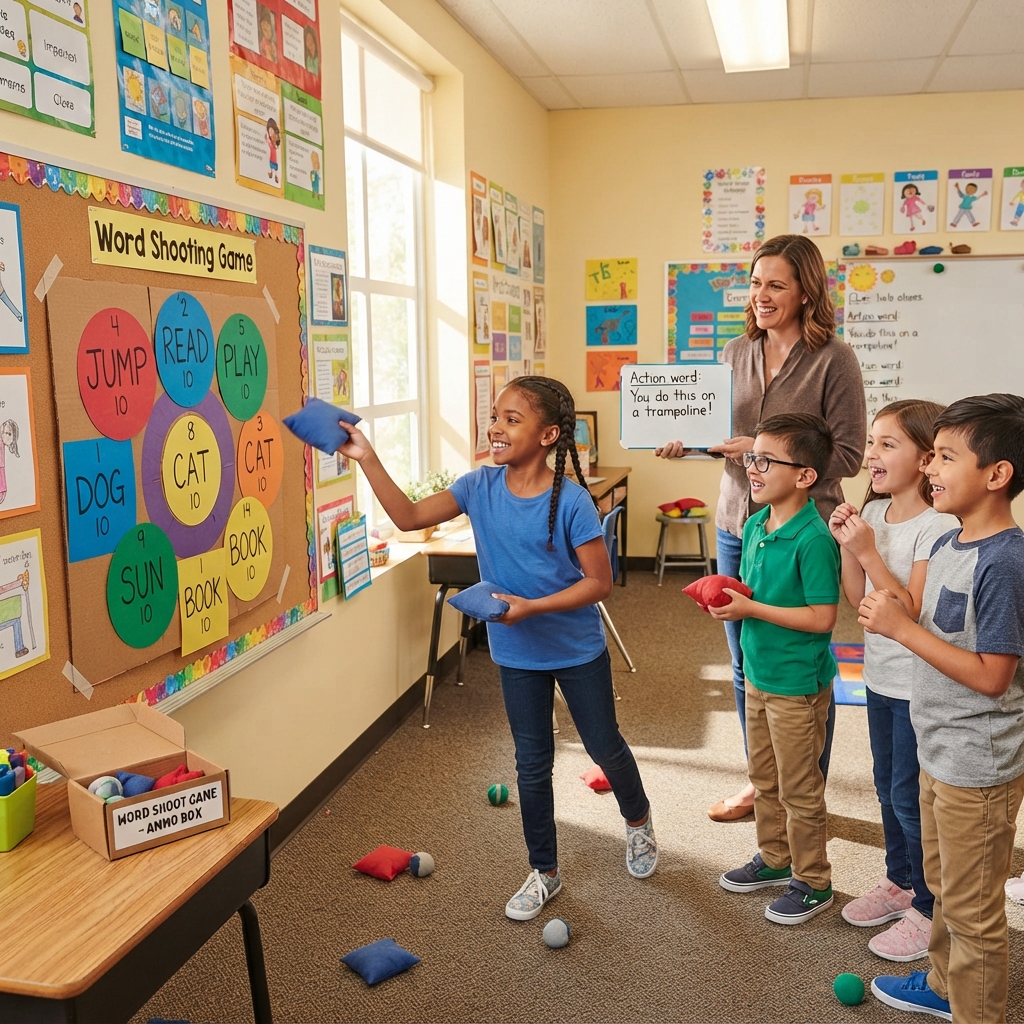
For a classroom version, the targets can be attached to a wall or placed on a table. A floor-based version can use targets arranged at different distances.
Creating the Targets
The targets are the main feature of the game. They can be made from cardboard plates, recycled boxes, paper circles, or colorful craft foam.
Each target should contain one word, letter, number, or picture.
For a vocabulary game, each target can contain a different vocabulary word. For a spelling game, each target can contain one letter.
The targets can be decorated with circles similar to traditional game targets. Different colors can be used to make the activity visually attractive.
The words should be large and clear enough for children to read easily.
Choosing the Words
The words should match the students’ learning level.
For younger children, simple words such as “cat,” “sun,” “red,” “book,” and “ball” may be appropriate.
Older students can practice longer vocabulary words, irregular spellings, synonyms, antonyms, or subject-specific terminology.
Teachers can create targets based on the lesson of the day. A science class might use words such as “plant,” “water,” “planet,” and “animal.” A mathematics activity could use numbers, shapes, or mathematical terms.
This flexibility makes the game useful across many subjects.
How to Play
The basic rules are simple. Several word targets are placed where players can see them clearly.
The teacher or game leader gives a clue. The student listens carefully and identifies the correct target.
The student then attempts to hit the target using the safe object chosen for the game.
If the student hits the correct word, they earn a point.
If the student hits the wrong word, the teacher can explain the correct answer and allow the student to try again.
The purpose is not only to win but also to reinforce learning.
A Vocabulary Version
The vocabulary version is one of the easiest ways to use the game.
Suppose students are learning animal names. The targets might say “lion,” “tiger,” “elephant,” “rabbit,” and “horse.”
The teacher can give clues such as “This animal has four legs and a long trunk.” The student must identify “elephant” and hit that target.
The activity encourages students to connect meaning with written words.
Pictures can also be included for younger learners who are still developing reading skills.
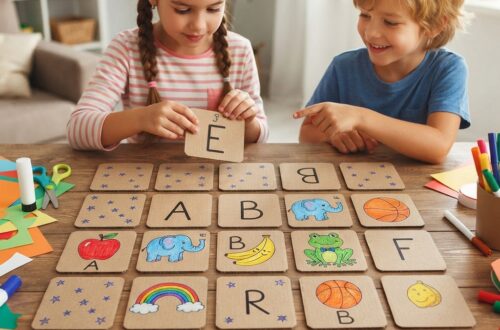
A Spelling Version
The word shooting game can also become a spelling activity.
Instead of putting complete words on the targets, individual letters are placed on them.
For example, if the target word is “BOOK,” students must find B, O, O, and K.
The teacher can call out the word, and students can hit the correct letters in order.
This version helps children practice letter recognition, spelling, and sequencing.
A Reading Version
The game can be adapted to reading practice by placing short sentences on the targets.
The teacher can read a question, and students must choose the sentence that answers it.
Another version uses word categories. Targets can contain nouns, verbs, adjectives, and other parts of speech.
Students might be asked to hit a verb or find a word that describes an object.
This transforms the activity into an active reading lesson.
A Picture and Word Game
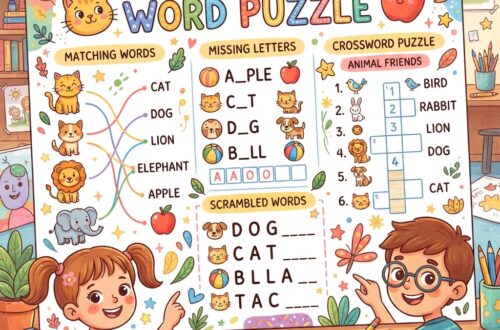
Combining pictures and words makes the activity accessible to younger children.
Each target can have a picture and its matching word.
For example, one target can show an apple and the word “apple,” while another shows a banana and the word “banana.”
The teacher can show a picture without saying the word. The student must identify the matching target.
This supports visual learning and vocabulary development.
Making the Game More Challenging
As students become better at the activity, teachers can increase the difficulty.
Targets can be placed farther apart or at different distances. More words can be added.
Students can also receive more complicated clues.
For example, instead of saying “Find the word dog,” the teacher might say, “Find the animal that is often kept as a household pet and can bark.”
Another challenge is giving students a limited amount of time to identify the correct target.
Team Competition
The word shooting game can be played in teams.
Students can be divided into two or more groups. Each team takes turns answering questions and hitting targets.
A correct answer can earn one point, while a correct answer followed by a successful hit can earn two points.
Team games encourage cooperation and communication.
However, competition should remain friendly. The main purpose should always be learning.
Educational Benefits
The word shooting game offers several educational benefits.
First, it encourages active participation. Students are not simply sitting and listening; they are moving, observing, reading, and responding.
Second, it can improve vocabulary retention. Connecting a word with an action can make the learning experience more memorable.
Third, the activity develops attention and concentration. Students must listen to the clue and quickly identify the correct target.
It can also improve confidence because children receive immediate feedback about their answers.
Developing Motor Skills
When safe throwing or aiming objects are used, the activity can also support basic hand-eye coordination.
Students must look at the target, judge its position, and control their movement.
Younger children can use large soft balls or beanbags, while older students can use other age-appropriate materials under supervision.
The physical component makes the activity different from traditional vocabulary exercises.
Using the Game at Home
Parents can create a simple version at home with paper and cardboard.
Several words can be written on pieces of paper and placed on the floor. A child can use a soft ball to hit the correct word after hearing a clue.
The activity can be adapted to homework. For example, a child can practice ten spelling words by turning them into ten targets.
Parents can also let children create the targets themselves. Designing the game becomes part of the learning process.
Using Recycled Materials
The word shooting game is ideal for recycling projects.
Old cardboard boxes can become targets. Used paper can be cut into circles and attached to cardboard.
This approach teaches children that craft activities do not always require new materials.
They can reuse packaging and other clean household materials to create educational games.
Safety Considerations
Safety is essential when designing a shooting game for children.
The game should never use real weapons, sharp objects, hard projectiles, or anything that could cause injury. Safe options include soft balls, beanbags, or pretend actions.
Targets should be placed away from windows, fragile objects, and other people.
Children should never aim at another person.
Adults or teachers should supervise the activity and select materials appropriate for the children’s ages.
Creating a Large Classroom Target
For a classroom display, a large cardboard target can become the centerpiece of the activity.
The center can contain a special word worth extra points.
Surrounding sections can contain vocabulary words.
Students can take turns trying to reach the correct section.
The target can be decorated with colorful borders and educational symbols.
This creates a reusable classroom resource that can be updated with new words.
Combining the Game With Other Subjects
The concept can be used beyond language lessons.
In science, targets can contain the names of animals, plants, planets, or body parts.
In mathematics, targets can contain numbers or equations.
In geography, students can hit the name of a country after hearing a clue.
In history, targets can contain historical terms or important dates.
This makes the word shooting game a flexible educational tool.
Conclusion
The word shooting game is a creative and engaging way to make learning more active. By combining words with targets, movement, and simple challenges, children can practice vocabulary, spelling, reading, numbers, and many other subjects while having fun.
The game is easy to create with cardboard, paper, markers, and safe throwing materials. Teachers and parents can adapt the rules according to the children’s ages and learning goals.
One of its greatest strengths is flexibility. It can be a simple vocabulary game for young children, a spelling challenge for elementary students, or a more advanced subject-learning activity for older learners.
The game also encourages recycling when old cardboard and paper are used to create the targets. Students can even design and decorate the targets themselves, adding another creative dimension to the activity.
Most importantly, a word shooting game can help children associate learning with positive experiences. Instead of seeing vocabulary practice as repetitive work, students can see it as a challenge that involves thinking, movement, and achievement.
When designed carefully and played safely, the word shooting game becomes much more than a craft or classroom competition. It is an interactive learning tool that can strengthen memory, concentration, vocabulary, coordination, creativity, and teamwork. With a few simple materials and a collection of carefully chosen words, an ordinary classroom can become an exciting place for active learning.