A memory game using letters and pictures is a simple, entertaining, and educational activity that helps children develop memory, concentration, vocabulary, letter recognition, and visual skills. The game can be made easily with cardboard, paper, colored pencils, markers, and pictures. It is especially useful for young children who are learning the alphabet and beginning to connect letters with words and objects.
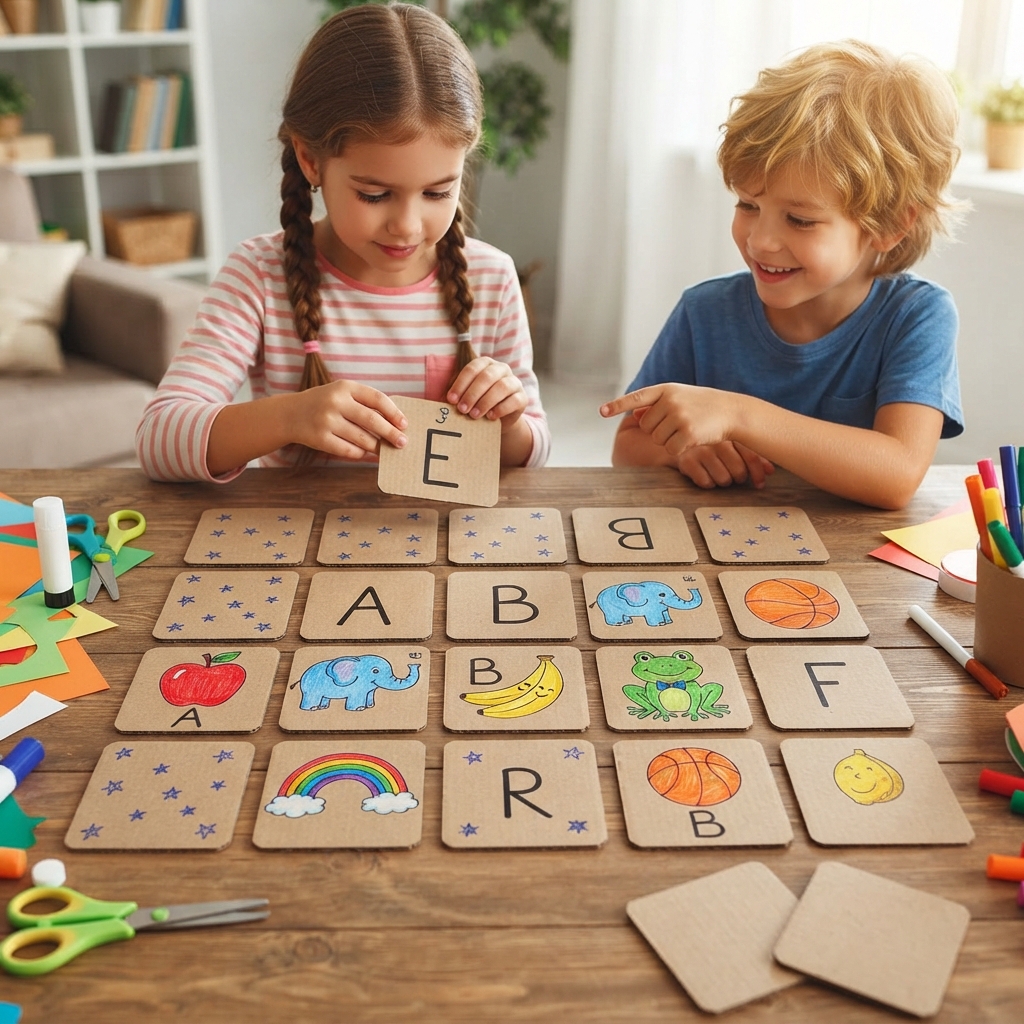
The basic idea is to create pairs of cards. One card may contain a letter, while another card contains a picture of an object that begins with that letter. Children place the cards face down, turn over two cards at a time, and try to find matching pairs. For example, a card showing the letter B can match a picture of a ball, while the letter C can match a picture of a cat.
This activity combines learning with play. Instead of memorizing letters from a textbook, children interact with colorful cards and actively search for connections.
What Is a Letter and Picture Memory Game?
A letter and picture memory game is a matching activity designed around the relationship between letters and familiar objects.
Each letter card has a corresponding picture card. The children must remember where the cards are located and find the correct pairs.
For example, the game might contain:
- A — apple
- B — ball
- C — cat
- D — dog
- E — elephant
The cards are mixed and placed face down. Players take turns turning over two cards. If the letter and picture match, the player keeps the pair and receives another turn. If they do not match, the cards are returned face down.
The winner can be the player with the most pairs at the end.
Materials Needed
The game can be made from simple and inexpensive materials.
Thick cardboard is useful because it makes the cards stronger and easier to handle. Colored paper can be used to cover the cards.
Children will also need scissors, glue, pencils, markers, crayons, and a ruler.
Pictures can be drawn by hand, cut from suitable printed materials, or created using simple shapes.
For a reusable version, the cards can be covered with a protective layer.
Using recycled cardboard from clean packaging is another excellent option.
Designing the Cards
The cards should be approximately the same size so that players cannot identify them from their shape.
A square or rectangular design works well.
Letter cards can have large, clear uppercase letters. Picture cards should contain simple and recognizable images.
A border can be added around each card to make it attractive.
It is important that the backs of all cards look similar. If different backs are used, children may be able to identify cards before turning them over, which would make the memory challenge less fair.
Choosing Letters and Pictures
The pictures should be familiar to children.
For the letter A, an apple is a simple choice.
For B, a ball or banana can be used.
For C, a cat or car is suitable.
For D, a dog or duck can represent the letter.
The vocabulary should match the child’s age and language level.
For beginners, common everyday objects are best. More advanced players can use less familiar vocabulary.
Preparing the Letter Cards
The letter cards should have one large letter in the center.
For example, the card might simply show:
A
The letter should be easy to recognize.
Uppercase letters are usually appropriate for beginners, while lowercase letters can be introduced later.
Teachers can also create pairs involving uppercase and lowercase letters. In that version, an uppercase A might match a lowercase a instead of a picture.
This provides additional alphabet practice.
Preparing the Picture Cards
Each picture card should clearly represent one word.
For example, a colorful apple can represent the letter A.
The word can also be written underneath the picture.
This creates an additional reading opportunity.
For younger children, the picture may be enough. For older children, adding the written word can help connect pictures, letters, and vocabulary.
How to Play
The game begins by placing all the cards face down on a table.
Players should mix the cards carefully.
The first player turns over two cards.
If the cards form a correct letter-picture pair, the player keeps them.
If they do not match, the player turns them face down again.
The next player takes a turn.
Players must remember the location of cards they have already seen.
The game continues until all pairs have been found.
The player with the most pairs wins.
Developing Memory Skills
The most obvious benefit of the activity is memory development.
Children must remember where different cards are located.
If a player sees the letter B in one position and later discovers the picture of a ball, they need to remember where the B card was located.
Repeated play strengthens memory and attention.
The game also teaches children to use information from previous turns.
Learning the Alphabet
The activity is especially valuable for children learning the alphabet.
Instead of seeing letters as isolated symbols, children connect each letter with a familiar object.
For example, the letter M becomes connected with a picture of a moon or monkey.
These visual associations can make letter learning easier and more memorable.
The game can begin with only a few letters and gradually expand to the complete alphabet.
Building Vocabulary
The picture cards introduce vocabulary naturally.
When a child matches the letter F with a picture of a fish, they are practicing both the letter and the word.
Parents and teachers can say the word aloud and ask children to repeat it.
They can also ask questions about the object.
For example, after matching “fish,” the teacher might ask, “Where does a fish live?”
This turns a simple matching game into a broader language activity.
Improving Concentration
Children must pay close attention during the game.
They need to remember where cards are placed, watch other players’ turns, and think about possible matches.
This helps develop concentration.
The activity can be especially useful for children who find long classroom exercises difficult because the game provides short, engaging challenges.
Developing Visual Recognition
The game also develops visual recognition.
Children learn to notice differences between letters and pictures.
They may compare similar letters such as B and D or P and Q.
Pictures also encourage children to identify shapes, colors, objects, and details.
This visual practice supports early reading and writing development.
Making the Game More Difficult
Once children understand the basic game, the rules can be made more challenging.
More cards can be added.
Instead of matching letters with pictures, players can match uppercase letters with lowercase letters.
Another version can match words with pictures.
For example, the word APPLE must be matched with a picture of an apple.
Older children can also match synonyms, categories, or related concepts.
A Classroom Version
Teachers can create a large classroom version of the game.
Cards can be displayed on a board or placed on the floor.
Students can take turns selecting cards.
The class can work together to find all the pairs.
A teacher can also use the cards as part of a lesson rather than a competitive game.
For example, students can match ten letters and then practice writing those letters on a worksheet.
A Home Learning Activity
Parents can easily make the game at home.
A small set of ten or twelve pairs is enough for a short activity.
Parents can let children help create the cards by drawing pictures and writing letters.
This gives children additional practice before the game even begins.
Playing for ten or fifteen minutes at a time can provide useful learning without making the activity feel like homework.
Encouraging Creativity
Children can create their own pictures for the cards.
They might draw a cartoon apple, a colorful bird, a funny dog, or an imaginary object.
This adds an artistic element to the project.
Children can also decorate the backs of the cards with stars, circles, or simple patterns.
Creating the cards helps them take ownership of the game.
Using Recycled Materials
The memory game is an excellent recycling craft.
Old cereal boxes, packaging cardboard, and other clean cardboard can be cut into card shapes.
Paper scraps can be used for decorations.
This teaches children that useful educational materials can be created from objects that might otherwise be thrown away.
The activity therefore combines learning with environmental awareness.
Playing as a Team
The game does not always need to be competitive.
Children can work together to find every pair.
A group can discuss where they remember seeing certain letters or pictures.
This encourages communication and cooperation.
For younger children, cooperative play may be more suitable than focusing on winning.
Common Challenges
One challenge is choosing pictures that clearly represent the correct letters.
Some letters have fewer simple words that young children recognize, so teachers should choose vocabulary carefully.
Another challenge is making the cards strong enough for repeated use.
Using cardboard instead of thin paper can improve durability.
If the cards become bent or damaged, they can be replaced easily because the game is inexpensive to make.
Safety Considerations
Children should use scissors carefully and follow age-appropriate instructions.
Adults can help younger children cut the cardboard.
Small pieces should be kept away from very young children who might put them in their mouths.
The cards should have smooth edges.
The game should be played on a clean, stable surface where the cards will not easily fall.
Conclusion
A memory game using letters and pictures is a simple but powerful educational activity for children. By combining alphabet practice with colorful pictures and a memory challenge, the game helps children develop several important skills at the same time.
Children learn to recognize letters, connect letters with words, build vocabulary, improve memory, strengthen concentration, and develop visual recognition. They also practice taking turns, following rules, communicating with others, and solving problems.
The game is easy to create using cardboard, paper, markers, glue, and simple drawings. Recycled materials can make it even more affordable and environmentally friendly.
The activity can also grow with the child. Beginners can match a few letters with familiar pictures, while more advanced learners can match uppercase and lowercase letters, words and pictures, or even more complex vocabulary.
Perhaps the most important feature of the game is that it makes learning enjoyable. Children are naturally curious about pictures and enjoy the challenge of discovering hidden cards. Every successful match provides a small sense of achievement, encouraging them to continue learning.
Whether used at home, in a classroom, or as part of a school craft exhibition, the letter and picture memory game is a wonderful example of learning through play. With simple materials and creative ideas, children can make their own educational game while developing the skills they need for reading, writing, communication, and future learning.