A school question cube is a creative and interactive educational project designed to make learning more exciting for children. It is usually made from cardboard or thick paper and shaped like a large cube. Each side of the cube contains questions, topics, challenges, pictures, or instructions related to school subjects. Students can roll, turn, or choose a side of the cube and then answer the question shown on it.
The school question cube is an excellent classroom activity because it combines learning, movement, creativity, and participation. Instead of simply answering questions from a textbook or worksheet, students can interact with a physical object. The cube can be used for mathematics, language, science, reading, general knowledge, spelling, history, geography, and many other subjects. It can also be decorated with bright colors and school-themed pictures, making it attractive to children.
What Is a School Question Cube?
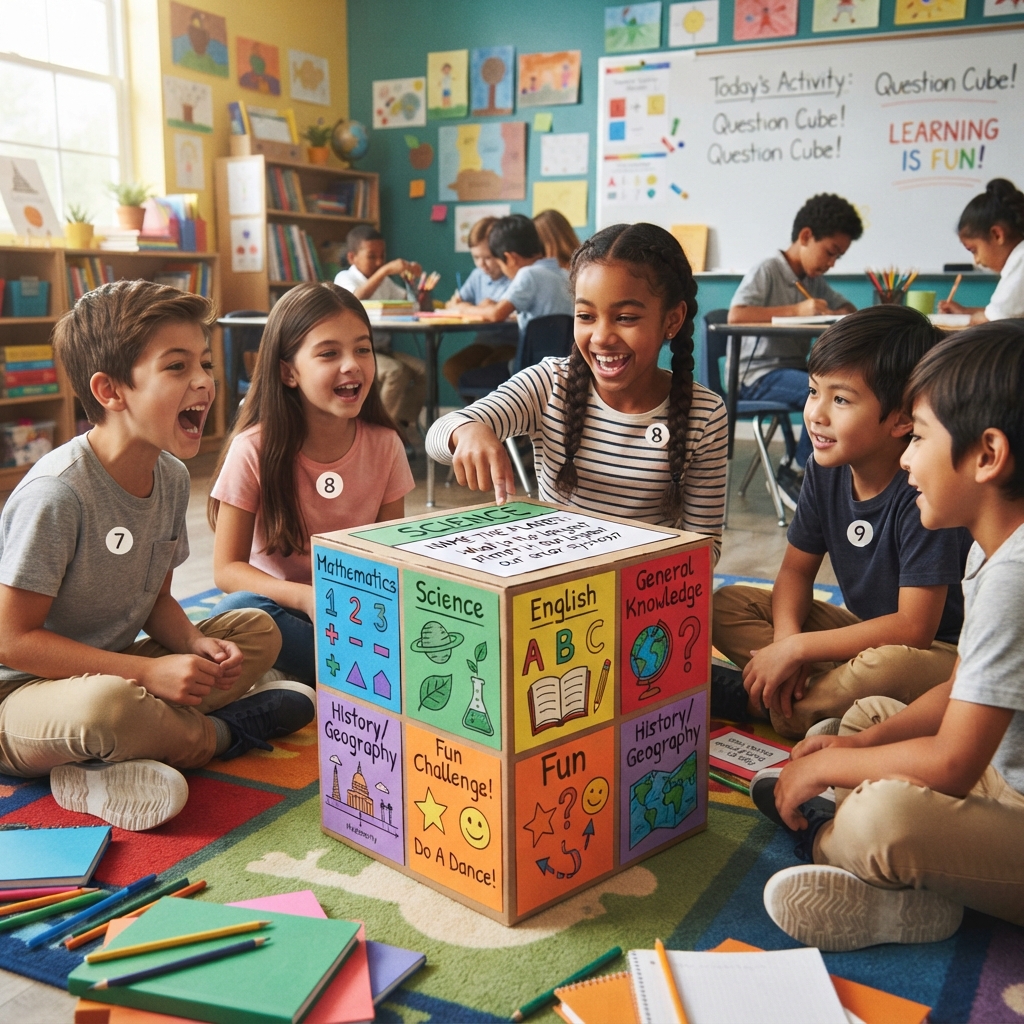
A school question cube is a three-dimensional learning tool that looks like a large box with six sides. Each side can have a different category or set of questions.
For example, one side might say “Mathematics,” another might say “Science,” and another might say “English.” The remaining sides could contain “General Knowledge,” “Fun Challenge,” and “Bonus Question.”
Students can roll the cube or select one side. They then answer the question connected with that section.
The cube can be used by one student or by an entire class. It can also become a team game in which groups compete to collect points by answering questions correctly.
Materials Needed
Making a school question cube does not require expensive supplies. Cardboard is one of the best materials because it is strong and easy to decorate.
Children may also need colored paper, scissors, glue, tape, a ruler, a pencil, markers, crayons, and printed or handwritten questions.
Old cardboard boxes can be recycled for the project. A cereal box or packaging box can provide useful cardboard.
Stickers, drawings, stars, numbers, letters, and school symbols can be added as decorations.
Using recycled materials makes the project affordable and teaches children about creative reuse.
Planning the Cube
Before constructing the cube, students should decide what they want to include on each side.
A simple plan can show six squares connected together in the shape of a cube. Each square represents one face of the finished model.
The questions should be chosen according to the students’ age and learning level.
For younger children, the questions can be short and simple. Older students can receive more difficult questions requiring reasoning and explanation.
Planning first helps make sure that the questions are balanced and that every side has a clear purpose.
Building the Cardboard Cube
A cube can be made by drawing six equal squares on a piece of cardboard and adding small tabs along the edges. The tabs can be folded and glued together to form the three-dimensional shape.
Children should measure the squares carefully so that the sides fit together properly.
The cube can also be constructed from an existing cardboard box. The box can be covered with colored paper and transformed into a question cube.
Once the structure is complete, the outside surfaces can be decorated.
Decorating the Question Cube
Decoration is an important part of the project because it makes the cube attractive and easy to use.
Each side can have a different color.
For example, the mathematics side can have numbers and geometric shapes, while the science side can have drawings of planets, plants, or animals.
The English side can contain letters and books, while the geography side can feature maps and globes.
Large headings can be written on each side so that students immediately understand the category.
Adding Questions
Questions can be written directly onto the cube or placed on removable cards.
Using cards is especially useful because the questions can be changed regularly.
For example, a mathematics cube can contain addition questions one week and multiplication questions the next.
A language cube can contain vocabulary questions, spelling challenges, or sentence-building tasks.
Removable question cards make the cube reusable for many lessons.
Mathematics Questions
Mathematics is one of the easiest subjects to include in a question cube.
A side can contain questions such as simple addition, subtraction, multiplication, division, fractions, shapes, or measurements.
For younger students, the teacher might ask, “What is 5 + 3?”
Older students might receive a problem requiring several steps.
The cube can also include visual mathematics questions. A picture of several shapes can be shown, and students can be asked to identify the number of triangles or circles.
This turns mathematics practice into an interactive game.
English and Language Questions
The question cube can be used to develop language skills.
One side might ask students to define a word, spell a word, identify a noun, or create a sentence.
Another question might ask students to name an adjective or find the opposite of a given word.
For reading lessons, students can answer questions about a short story.
The cube can also be used for speaking activities. A student may roll the cube and then speak about a topic for thirty seconds.
This helps develop vocabulary, communication, and confidence.
Science Questions
Science questions can make another side of the cube educational and exciting.
Students can be asked to name a planet, identify an animal, describe the water cycle, or explain why plants need sunlight.
For younger children, pictures can accompany the questions.
For older students, questions can require explanations rather than one-word answers.
The cube can be updated whenever the class begins a new science topic.
General Knowledge
A general knowledge side can contain questions about the world.
Students might be asked to identify a country, name an ocean, recognize a famous landmark, or answer a simple fact-based question.
General knowledge questions can encourage children to become curious about the world around them.
The teacher can also include questions about school life, nature, sports, books, and everyday objects.
Fun Challenge Questions
Not every question needs to be academic.
A “Fun Challenge” side can contain activities such as:
- Name three animals.
- Say five words beginning with the letter B.
- Act like an animal.
- Draw a star in ten seconds.
- Name three things found in a classroom.
- Spell your favorite school subject.
These activities give students a break from traditional questions while still developing useful skills.
How to Play the Game
The rules can be very simple.
Students sit or stand in a circle. One student rolls the question cube or chooses a side.
The teacher reads the question associated with that side.
If the student answers correctly, they receive a point.
If the answer is incorrect, the teacher can explain the correct answer. The next student then takes a turn.
The game can continue until everyone has participated.
Playing in Teams
The question cube can also become a team activity.
Students can be divided into two or more teams. Each team takes turns rolling the cube.
A correct answer earns a point. A difficult question can be worth two points.
Teams can work together to discuss their answers before responding.
This encourages cooperation and communication.
The teacher should emphasize that the goal is learning rather than simply winning.
Educational Benefits
The school question cube offers many educational benefits.
First, it encourages active participation. Students have a physical object to interact with rather than simply reading questions from a page.
Second, it can improve memory. Students often remember information more easily when it is connected to an enjoyable activity.
Third, the cube encourages students to listen carefully and think quickly.
It can also help shy students participate because the game creates a relaxed and playful environment.
Developing Communication Skills
Students can use the cube to practice speaking.
Instead of simply giving short answers, they can be asked to explain their thinking.
For example, after solving a mathematics problem, a student can describe the steps used to find the answer.
In a language activity, students can create sentences using new vocabulary.
These activities help students communicate ideas clearly.
Encouraging Creativity
Making the cube is itself a creative activity.
Students can decide on colors, drawings, categories, questions, and decorations.
They can design a special cube based on their favorite school subject.
For example, an art student might create a cube containing drawing challenges, while a science student might create one filled with scientific questions.
This gives students a sense of ownership over their learning tool.
Using Recycled Materials
The question cube is an excellent recycling project.
Old cardboard packaging can become the main structure, while paper scraps can be used for labels and decorations.
This teaches students that materials that might normally be thrown away can be transformed into useful objects.
The activity can therefore combine education with environmental awareness.
Making a Portable Cube
A smaller question cube can be designed for individual use.
Students can keep it on their desks and use it during independent practice.
A teacher can prepare several small cubes for different groups.
Each group can have a different subject cube, allowing students to rotate between activities.
This makes the classroom more dynamic.
Common Challenges
One challenge is making sure that the cube is strong enough.
Thin paper may bend or collapse, so cardboard is usually a better choice.
Another challenge is making equal-sized sides. Measuring carefully with a ruler can help.
If the cube is difficult to fold, the cardboard may be too thick. In that case, the folding lines can be scored carefully by an adult.
The questions should also be appropriate for the students’ level. Questions that are too difficult can discourage younger learners.
Safety Considerations
Children should use scissors carefully and follow age-appropriate instructions.
Adults may need to help with thick cardboard.
Glue should be used responsibly, and the work area should be kept clean.
The finished cube should have smooth edges so that students can handle it safely.
If the cube is large, it should not be thrown toward people or fragile objects. The word “roll” should mean rolling it gently on a safe surface.
Using the Cube for Review
The school question cube is particularly useful before a test.
A teacher can prepare questions covering the most important topics from a recent unit.
Students can roll the cube and review information through a game.
This can make revision less stressful and more enjoyable.
The teacher can also identify areas where students need additional practice.
Creating a School-Themed Display
A large question cube can become part of a classroom display.
It can be placed on a table with books, pencils, miniature school supplies, and other educational crafts.
The six sides can represent different subjects.
Students can decorate the surrounding display with paper stars, letters, numbers, and colorful school symbols.
This creates an attractive learning corner.
Conclusion
The school question cube is a creative and practical educational activity that makes learning more interactive. Made from simple materials such as cardboard, paper, glue, and markers, the cube can become a reusable classroom tool for asking questions, reviewing lessons, and encouraging student participation.
Its six sides provide many possibilities. One side can focus on mathematics, another on science, another on English, while the remaining sides can include general knowledge, speaking activities, and fun challenges.
The cube can be used by individual students, small groups, or entire classes. It can also be adapted for different ages and subjects. Removable question cards make it possible to change the content whenever a new lesson begins.
The project provides benefits beyond academic learning. Children develop creativity while designing the cube, fine motor skills while cutting and assembling it, and communication skills while answering questions. Team games can also encourage cooperation and respectful interaction.
Using recycled cardboard makes the project environmentally friendly and inexpensive. Children learn that ordinary materials can be transformed into useful educational tools through imagination and careful work.
Most importantly, the school question cube shows that learning does not always have to happen through traditional worksheets and textbooks. A colorful handmade cube can turn a normal lesson into an engaging activity filled with questions, movement, discussion, and discovery.
Whether used for classroom revision, a school exhibition, a home learning activity, or a creative educational project, the school question cube is a simple idea with many possibilities. It brings together art and education while helping children learn in an active, memorable, and enjoyable way.
:::