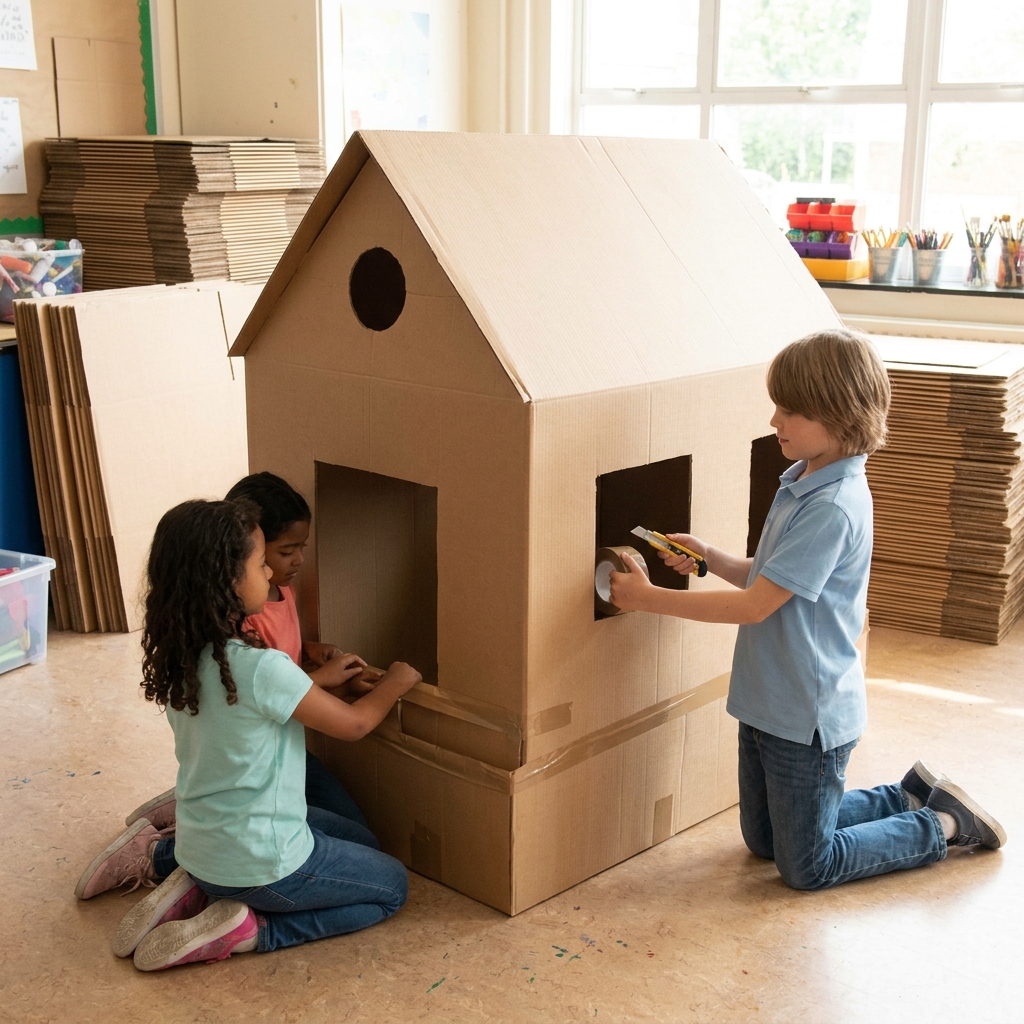
Creative school projects give children the opportunity to learn through hands-on experiences while developing valuable life skills. Among the many craft and construction activities available for young learners, one project consistently stands out as a favorite: building a DIY cardboard playhouse. Using large recycled cardboard boxes and simple craft materials, children can design, decorate, and assemble their own miniature house. The project combines art, engineering, teamwork, imagination, and environmental awareness into a single engaging activity.
A cardboard playhouse is much more than a simple craft. It becomes a place where children can dream, imagine, read, play, and create stories. Whether it becomes a fairy cottage, a firefighter station, a castle, a space station, or a tiny family home, every playhouse reflects the imagination of its young builders.
Teachers, parents, and homeschool educators appreciate this project because it is affordable, environmentally friendly, and adaptable to children of different ages. Best of all, the finished playhouse continues to provide entertainment and educational opportunities long after construction is complete.
Why Children Love Building a Cardboard Playhouse
Children naturally enjoy creating things with their own hands. Constructing a cardboard playhouse gives them a sense of ownership and accomplishment. Instead of simply receiving a toy, they build something unique from start to finish.
There are many reasons this activity is so popular:
- Children enjoy working with large materials.
- They can personalize every part of the house.
- They love pretending the playhouse is their own home.
- Decorating encourages artistic creativity.
- Building together strengthens friendships.
- Finished houses become exciting places for imaginative play.
Unlike many craft projects that are completed in less than an hour, a cardboard playhouse can become a multi-day project that keeps students engaged and motivated.
Educational Goals of the Project
Although the activity feels like play, it supports many important learning objectives.
Children develop:
- Creativity
- Problem-solving abilities
- Fine motor skills
- Gross motor coordination
- Teamwork
- Communication
- Planning
- Measurement skills
- Spatial awareness
- Environmental responsibility
- Self-confidence
- Imagination
Because the project integrates several subjects, it fits perfectly into project-based learning programs.
Materials Needed
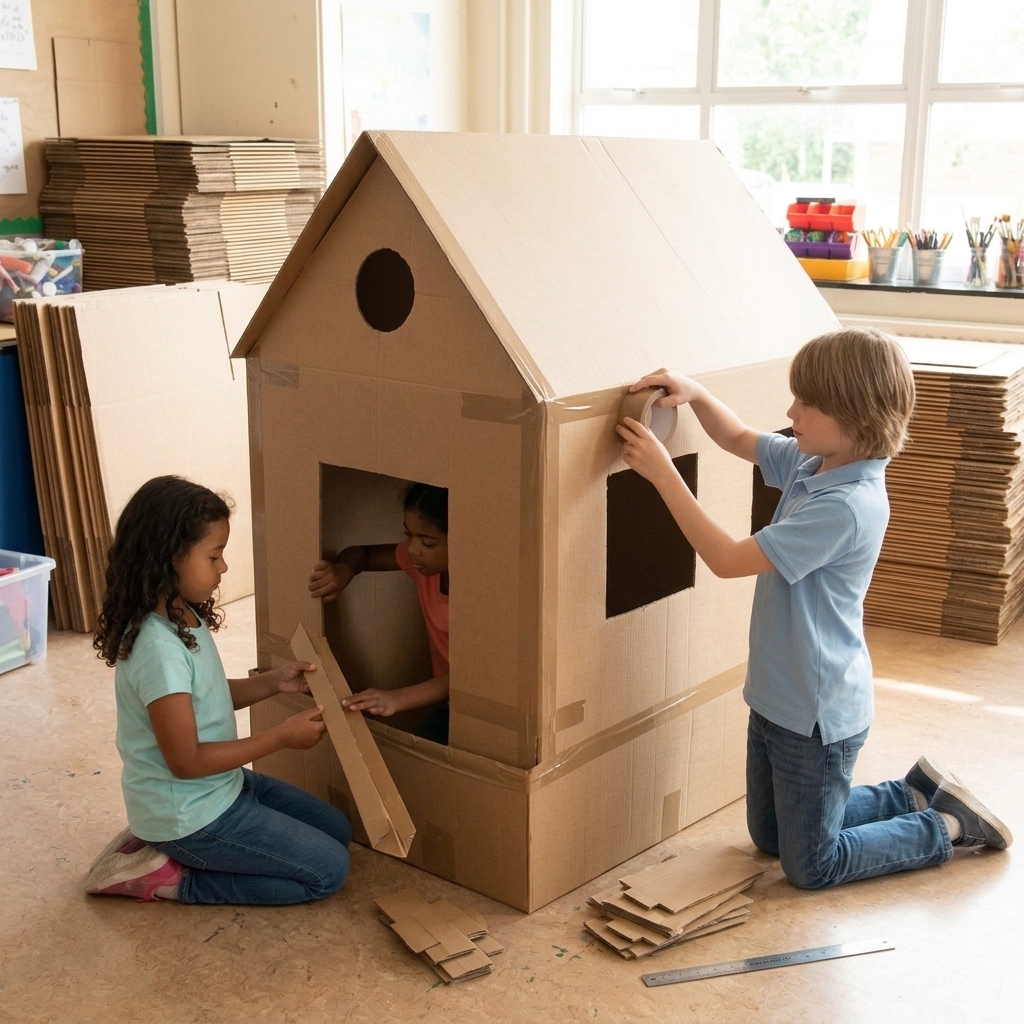
One of the greatest advantages of this project is that most materials are inexpensive or recycled.
Essential supplies include:
- Large cardboard boxes
- Packing tape
- Child-safe scissors
- Craft knives (adult use only)
- Glue
- Colored paper
- Paint
- Paintbrushes
- Markers
- Rulers
- Pencils
- Decorative stickers
- Fabric scraps
- Construction paper
- String
- Washi tape
- Foam sheets
Optional decorations include:
- Curtains made from fabric
- Bottle caps for door handles
- Cardboard flower boxes
- Recycled plastic lids
- LED battery lights
- Pom-poms
- Glitter
- Craft foam letters
Preparing the Cardboard
Before construction begins, children examine the cardboard boxes.
Teachers help remove old tape and labels.
Boxes are flattened if necessary and then carefully measured.
Adults cut the major openings while children assist with safe tasks.
Planning the layout before cutting prevents mistakes and encourages thoughtful design.
Designing the Playhouse
Every successful construction project begins with a plan.
Students first decide what type of house they want to build.
Ideas include:
- Family house
- Cottage
- Castle
- Treehouse
- Fire station
- Bakery
- Library
- Pet house
- Pirate cabin
- Space station
- Police station
- Princess palace
- Mountain cabin
Children sketch simple floor plans before beginning construction.
This step introduces basic architectural thinking.
Measuring and Drawing
Teachers demonstrate how to measure walls, windows, and doors using rulers or measuring tapes.
Students practice:
- Drawing straight lines
- Measuring equal lengths
- Comparing sizes
- Estimating distances
These activities naturally reinforce mathematics skills.
Building the Walls
The cardboard walls are assembled using tape or glue.
Students work together to:
- Hold pieces in place
- Attach corners
- Reinforce weak areas
- Check balance
Cooperation is essential during this stage.
Children quickly discover that teamwork makes construction much easier.
Creating Doors and Windows
One of the most exciting moments is cutting the doors and windows.
Teachers carefully cut the openings while students decorate around them.
Children may add:
- Window shutters
- Flower boxes
- Curtains
- Doorbells
- Mailboxes
- Welcome signs
These details give every house personality.
Building the Roof
The roof presents an interesting engineering challenge.
Children experiment with different roof styles:
- Flat roof
- Triangle roof
- Cottage roof
- Curved roof
- Castle towers
Teachers encourage students to test which designs are strongest.
This introduces basic engineering concepts without complicated explanations.
Decorating the Exterior
Now creativity takes center stage.
Students paint:
- Brick walls
- Wooden boards
- Stone patterns
- Rainbow houses
- Forest cabins
Some children decorate with flowers and butterflies.
Others create spooky haunted houses or colorful fairy cottages.
There are no limits to imagination.
Decorating the Interior
Inside the playhouse, children continue adding creative features.
Ideas include:
- Cardboard furniture
- Tiny bookshelves
- Wall paintings
- Rugs made from felt
- Toy fireplaces
- Pretend kitchens
- Reading corners
- Family portraits
- Paper clocks
The interior often becomes just as exciting as the outside.
Learning About Recycling
The project naturally teaches sustainability.
Children realize that large cardboard boxes do not need to become waste.
Teachers explain:
- Reduce
- Reuse
- Recycle
Students begin noticing how many household items can become useful craft materials.
Environmental awareness develops through experience rather than lectures.
Developing Engineering Skills
Building a cardboard house introduces basic engineering ideas.
Children learn about:
- Balance
- Stability
- Strong corners
- Structural support
- Weight distribution
When walls collapse or roofs bend, students solve problems through experimentation.
These experiences build resilience and critical thinking.
Encouraging Creativity
Every playhouse reflects its builder’s imagination.
One child may design a medieval castle.
Another creates a jungle hut.
Someone else imagines an underwater submarine home.
Because every design is different, children feel proud of their originality.
Improving Communication Skills
Throughout construction, students discuss ideas with classmates.
They ask questions such as:
“Should we make another window?”
“Where should the door go?”
“What color should we paint the roof?”
These conversations strengthen vocabulary, listening, and cooperation.
Supporting Social Development
Group construction teaches valuable social skills.
Students practice:
- Sharing materials
- Taking turns
- Respecting opinions
- Solving disagreements
- Helping classmates
The finished playhouse becomes a symbol of teamwork.
Using the Playhouse for Learning
Once completed, the cardboard house becomes a versatile educational tool.
Teachers use it for:
Language lessons
Storytelling
Reading practice
Drama activities
Role-playing
Science discussions
History projects
Community helpers lessons
The house continues supporting learning throughout the school year.
Storytelling Activities
Children enjoy creating stories involving their playhouse.
Examples include:
- The Little Forest Cottage
- The Friendly Monster House
- Grandma’s Cozy Cabin
- The Detective Headquarters
- The Magical Wizard Home
- The Arctic Explorer Shelter
Storytelling improves literacy while encouraging imagination.
Seasonal Decorations
The same playhouse can change throughout the year.
Spring:
Paper flowers
Butterflies
Green vines
Summer:
Beach decorations
Sunshine murals
Garden themes
Autumn:
Pumpkins
Leaves
Harvest decorations
Winter:
Snowflakes
Paper icicles
Holiday lights
Seasonal changes keep the project exciting for months.
Home Extension Activities
Parents can continue the fun after school.
Ideas include:
Adding cardboard furniture.
Making toy pets.
Building a cardboard garage.
Creating a mailbox.
Designing a garden.
Painting new decorations.
Writing family stories.
The project becomes an ongoing family activity.
Classroom Challenges
Teachers may organize creative competitions.
Examples include:
Best recycled materials
Most colorful house
Strongest structure
Most imaginative design
Best teamwork
Best storytelling performance
Every child can receive recognition for different strengths.
Safety Considerations
Safety should always come first.
Teachers remind children to:
Use scissors carefully.
Keep workspaces clean.
Ask adults before using sharp tools.
Avoid running near construction areas.
Wash hands after painting.
Adult supervision ensures a safe learning environment.
Common Construction Problems
Not every project goes perfectly.
Sometimes:
Walls lean.
Roofs collapse.
Tape loses its grip.
Paint smudges.
Windows become uneven.
These challenges teach children that mistakes are part of learning.
Instead of becoming discouraged, students discover new ways to solve problems.
Skills Developed During the Project
By the end of construction, children have strengthened many important abilities.
These include:
Creative thinking
Planning
Organization
Decision-making
Fine motor coordination
Communication
Engineering awareness
Environmental responsibility
Persistence
Self-confidence
Collaboration
Presentation skills
These skills support success in many future learning experiences.
Presenting the Finished Playhouses
After construction is complete, each group presents its playhouse.
Students explain:
Why they chose the design.
How they solved problems.
Which materials they used.
What they learned.
What they would improve next time.
Public presentations build speaking confidence and encourage reflection.
Long-Term Benefits
Unlike many classroom crafts that are displayed briefly and then taken home, cardboard playhouses continue serving educational purposes.
Children use them for:
Pretend play
Reading corners
Drama performances
Group discussions
Photography
Creative writing inspiration
Classroom games
The project continues enriching learning long after construction ends.
Tips for Teachers
Successful cardboard playhouse projects often include:
Preparing materials ahead of time.
Providing examples without limiting creativity.
Assigning team roles.
Allowing enough construction time.
Celebrating effort rather than perfection.
Displaying finished houses proudly.
Encouraging storytelling after construction.
Most importantly, teachers should allow children to make creative decisions whenever possible.
Conclusion
Building a DIY cardboard playhouse is one of the most enjoyable and educational projects children can experience. It combines creativity, recycling, engineering, mathematics, communication, teamwork, and imaginative play into a memorable hands-on activity that inspires curiosity and confidence. By transforming ordinary cardboard boxes into colorful houses, castles, cottages, or imaginative dream homes, children discover that creativity is more important than expensive materials.
The project teaches valuable lessons about planning, cooperation, problem-solving, and environmental responsibility while giving every child the opportunity to express unique ideas. The finished playhouse becomes much more than a craft—it becomes a space for storytelling, dramatic play, reading, friendship, and endless adventures.
Whether completed in a classroom, at home, in a community center, or during a summer camp, a cardboard playhouse encourages children to think like designers, builders, artists, and storytellers. Most importantly, it reminds them that with imagination, teamwork, and a few recycled materials, they can create something extraordinary. The memories made while building and playing inside their own handmade cardboard house will stay with them for many years, inspiring a lifelong appreciation for creativity, learning, and sustainable living.