The educational number wheel is a creative and interactive learning tool designed to help children understand numbers and basic mathematics in an enjoyable way. It can be made from cardboard, paper plates, colored paper, or other simple materials. The wheel usually contains numbers, mathematical symbols, questions, or colorful sections that children can turn, point to, or spin to create different learning activities.
Mathematics is an important part of everyday life, but some children may find numbers difficult or repetitive when they are taught only through traditional worksheets. An educational number wheel provides a different approach. It turns number practice into a hands-on activity where children can touch, move, observe, count, compare, and solve problems.
The number wheel can be used at home, in classrooms, learning centers, and school exhibitions. It can be adapted for young children learning to recognize numbers or for older students practicing addition, subtraction, multiplication, division, fractions, and other mathematical concepts.
What Is an Educational Number Wheel?
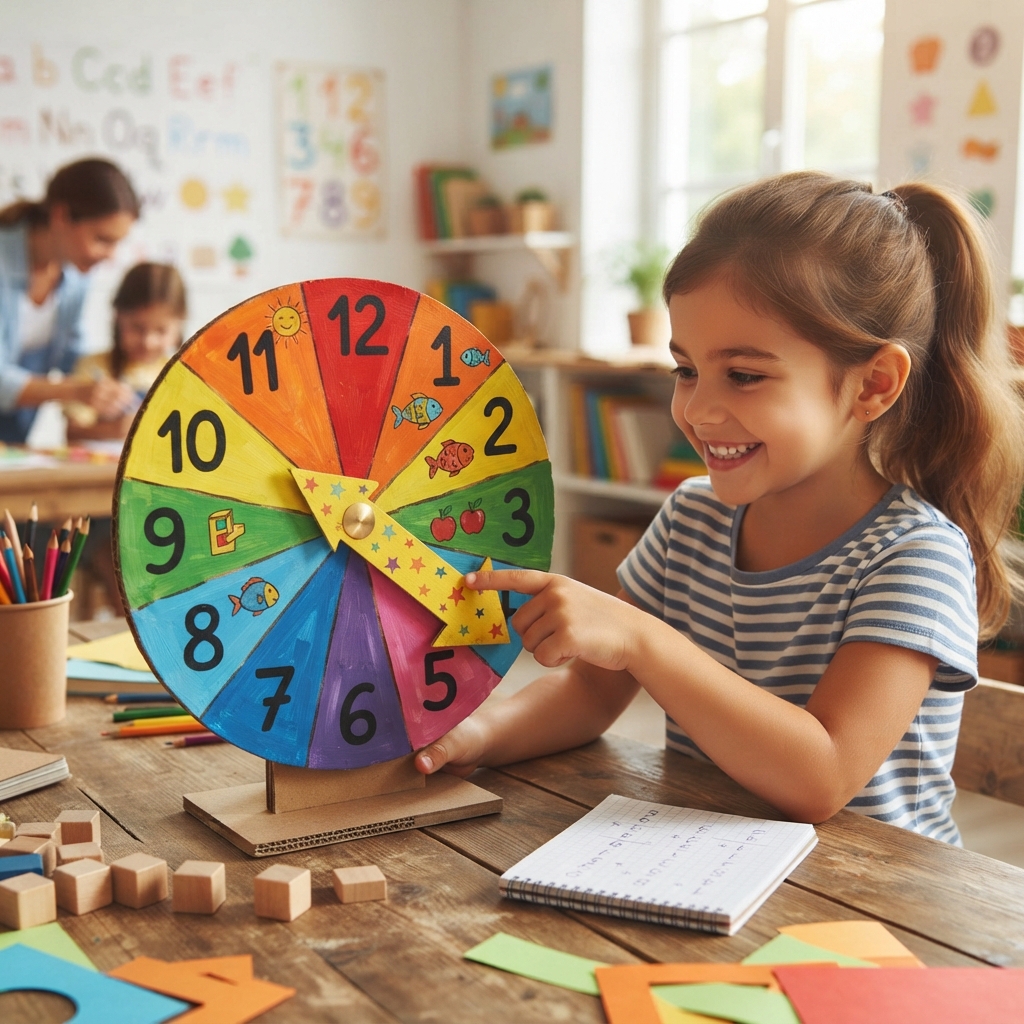
An educational number wheel is a circular learning model divided into different sections. Each section can contain a number, mathematical operation, question, or challenge.
A simple number wheel might contain the numbers 1 to 10. A child can spin the wheel and identify the number where the pointer stops.
A more advanced wheel can contain addition problems, multiplication questions, or mathematical symbols.
For example, the wheel might contain numbers from 1 to 12. A student spins it twice and uses the two selected numbers to create an addition problem.
The design can be changed according to the learning goals of the activity.
Materials Needed
The number wheel can be made with inexpensive materials. A strong piece of cardboard can provide the base.
A paper plate can also be used as a ready-made circular shape.
Other materials include colored paper, markers, pencils, scissors, glue, a ruler, and a paper fastener.
A small cardboard arrow can act as the pointer.
Stickers and decorative shapes can be added to make the wheel attractive.
Recycled cardboard is particularly useful because it provides a strong base and teaches children about reusing materials.
Planning the Number Wheel
Before making the wheel, children should decide what they want to learn.
A beginner’s wheel might focus on number recognition.
A counting wheel could contain numbers from 1 to 20.
An addition wheel could contain numbers and plus signs.
A multiplication wheel could include multiplication facts.
The number of sections should also be considered. Six, eight, ten, or twelve sections are easy to create.
Planning the design before cutting helps ensure that the numbers are evenly distributed around the wheel.
Creating the Circular Base
A large circle can be drawn on cardboard using a plate or another round object as a guide.
The circle should then be cut carefully.
The wheel can be covered with colored paper or divided into sections using markers.
Each section can have a different color, although the numbers should remain easy to read.
A strong cardboard base is important because the wheel may be used repeatedly.
Dividing the Wheel Into Sections
The circle can be divided into equal sections.
A ruler can be used to draw lines from the center to the outer edge.
Each section becomes a space for a number or question.
For example, a ten-section wheel can contain the numbers 1 through 10.
A twelve-section wheel can contain the numbers 1 through 12.
Students can practice mathematics while creating the wheel because dividing a circle into equal parts introduces ideas about measurement and geometry.
Adding the Pointer
The pointer is one of the most important parts of the number wheel.
It can be made from a narrow piece of cardboard with a pointed end.
A small hole can be made near the center of the pointer and another hole in the center of the wheel.
A paper fastener can connect the two pieces.
The pointer should be able to rotate freely.
Children can gently spin the pointer and wait for it to stop on a number.
Learning Number Recognition
One of the simplest uses of the wheel is number recognition.
A teacher can ask a child to spin the wheel and say the number selected.
The child can then find the same number on a worksheet, write it down, or show the corresponding number of objects.
For example, if the wheel stops at 7, the child can count seven blocks or draw seven stars.
This connects written numbers with quantities.
Practicing Counting
The number wheel can help young children practice counting.
After spinning the wheel, the child can count objects until reaching the selected number.
If the wheel lands on 5, the child might count five pencils, five buttons, or five paper shapes.
The activity helps children understand that numbers represent quantities.
Counting can also be practiced backward. If the wheel lands on 8, the teacher can ask the child to count backward from 8 to 1.
Addition Activities
The number wheel can become an addition game.
A student spins the wheel twice and records the two numbers.
For example, the first spin may produce 4 and the second may produce 6.
The student then solves:
4 + 6 = 10
The activity can be played individually or with classmates.
For younger students, physical objects can be used to demonstrate the answer.
Subtraction Activities
The same idea can be used for subtraction.
A student spins the wheel twice and uses the larger number first.
If the numbers are 9 and 3, the student solves:
9 – 3 = 6
This helps children practice subtraction while making the activity more interactive.
The teacher can provide support if the student needs help understanding which number should come first.
Multiplication Practice
For older children, the number wheel can be used for multiplication.
Two spins can create a multiplication problem.
For example:
4 × 7 = 28
Students can write the problem on paper or a small whiteboard.
The activity is especially useful for practicing multiplication tables.
A teacher can also create a special multiplication wheel with multiplication facts already printed around the edge.
Division Practice
Division can also be incorporated into the number wheel.
A teacher can select two numbers and ask students to create a simple division problem.
For example:
12 ÷ 3 = 4
The activity can be adapted for the student’s level.
Physical objects can help younger students understand division as sharing. Twelve counters can be divided equally into three groups.
Learning Even and Odd Numbers
The number wheel can also teach children to identify even and odd numbers.
Some sections can contain numbers, and students must say whether the selected number is even or odd.
The teacher can ask follow-up questions such as, “What number comes before it?” or “What number comes after it?”
This adds additional practice without changing the basic wheel.
Comparing Numbers
Another useful activity is number comparison.
A student spins the wheel twice.
The student then decides which number is greater and which is smaller.
For example, if the wheel produces 8 and 5, the student can say:
8 is greater than 5.
This activity helps children understand mathematical comparison symbols such as greater than, less than, and equal to.
Using the Wheel for Fractions
An advanced number wheel can be used to introduce fractions.
Sections can show fractions such as 1/2, 1/3, and 1/4.
Students can identify the fractions or compare them.
The wheel can also be divided into colored parts to provide a visual representation of fractions.
For example, half of a circle can be shaded to represent one-half.
This connects the physical model with an abstract mathematical idea.
Geometry and Shapes
The educational number wheel can also incorporate geometry.
Different sections can contain shapes such as circles, triangles, squares, and rectangles.
Students can spin the wheel and identify the selected shape.
Older children can count the sides or corners of the shape.
The activity shows that a single educational tool can support several areas of mathematics.
Educational Benefits
The educational number wheel provides many benefits.
First, it encourages active learning. Children interact physically with the wheel rather than simply looking at numbers on a page.
Second, it can improve number recognition and mathematical fluency through repeated practice.
Third, it supports concentration because students must watch the pointer and remember the selected number.
The activity can also make children more confident because they can practice without feeling that every activity is a formal test.
Developing Fine Motor Skills
Making and using the wheel can help children develop fine motor skills.
Cutting the cardboard, drawing lines, coloring sections, and attaching the pointer require controlled hand movements.
Spinning the pointer also involves hand coordination.
These physical actions can complement traditional mathematics exercises.
Encouraging Independent Learning
The number wheel can be used without constant teacher assistance.
A child can spin it, record the number, and complete a task independently.
For example, a student can spin twice and create an addition problem.
This encourages children to take responsibility for their own learning.
Parents can also use the wheel at home for short daily practice sessions.
Using the Wheel in Group Games
The number wheel is excellent for group activities.
Students can sit in a circle and take turns spinning.
Each student can answer a question based on the selected number.
A correct answer can earn a point.
Teachers can create friendly team competitions where students work together to solve problems.
The activity should remain positive and supportive so that children who make mistakes do not feel embarrassed.
Recycling and Creativity
Using recycled cardboard for the wheel teaches environmental responsibility.
Old boxes, packaging, and paper can be transformed into a useful learning tool.
Children can decorate the wheel with their own drawings and designs.
This combines mathematics with art and craft.
Students can also create different wheels for different subjects, turning the activity into a collection of handmade educational games.
Common Challenges
One challenge is making the wheel rotate smoothly.
The central hole should be positioned carefully, and the fastener should not be tightened too much.
Another challenge is making the sections equal.
Using a ruler and carefully marking the center can help.
If the cardboard is weak, a second layer can be added.
The numbers should also be large and clear enough for children to read.
Safety Tips
Children should use scissors carefully and follow age-appropriate instructions.
Adults may need to assist with cutting thick cardboard.
The paper fastener should be attached securely so that it does not become a sharp or loose piece.
The wheel should be used gently and should not be thrown.
A clean, organized workspace makes the craft safer and easier.
Conclusion
The educational number wheel is a simple but powerful learning tool that combines mathematics, creativity, movement, and hands-on exploration. Made from cardboard, paper, and a few basic craft supplies, it can help children practice numbers in a way that feels like a game rather than a traditional exercise.
The wheel can be used for number recognition, counting, addition, subtraction, multiplication, division, fractions, number comparison, even and odd numbers, and geometry. Its flexibility means that teachers and parents can change the activity according to the child’s age and learning needs.
The project also provides important creative benefits. Children can design and decorate their own wheels while practicing measurement, cutting, coloring, and construction. Using recycled cardboard makes the activity inexpensive and environmentally friendly.
Most importantly, the educational number wheel encourages children to interact with mathematics. Instead of simply looking at numbers, they can spin, count, compare, calculate, discuss, and solve problems.
Whether used at home, in a classroom, or as part of a school exhibition, the number wheel can become an engaging educational resource. It demonstrates that mathematics can be active, colorful, and enjoyable. With a simple cardboard circle and a little imagination, children can create a learning tool that turns everyday number practice into an exciting hands-on experience.